A mostly pictorial blog about the day to day life in our beautiful Oasis - El Rio De Aguas, Almeria, Spain.
Wednesday, 17 June 2015
Monday, 15 June 2015
Sunday, 14 June 2015
Saturday, 7 February 2015
Enlace creado por José MarÃa Calaforra y Ecologistas en Acción
Este enlace creado por José MarÃa Calaforra y Ecologistas en Acción contiene Denuncias Y Escritos 5 artÃculos - Documentos
10 artÃculos - Noticias, ArtÃculos, VÃdeos 9 artÃculos - Presentaciones
5 artÃculos - Manifiesto de Ecocidio de El Rio De Aguas.
https://drive.google.com/folderview?id=0B6_BawA6RrUBflNSdW5CUVphQjktNFQ0RkJsTENERTloelFyTkRCYlNuZDBTYjVHWWhNYlk&usp=sharing&tid=0B6_BawA6RrUBfk9jLWFxQmVKSmhieTdfd0NsakIxMFpXZ0tMb3J3Z2xiUjFmZ1NZOU14ZGM
10 artÃculos - Noticias, ArtÃculos, VÃdeos 9 artÃculos - Presentaciones
5 artÃculos - Manifiesto de Ecocidio de El Rio De Aguas.
https://drive.google.com/folderview?id=0B6_BawA6RrUBflNSdW5CUVphQjktNFQ0RkJsTENERTloelFyTkRCYlNuZDBTYjVHWWhNYlk&usp=sharing&tid=0B6_BawA6RrUBfk9jLWFxQmVKSmhieTdfd0NsakIxMFpXZ0tMb3J3Z2xiUjFmZ1NZOU14ZGM
Tuesday, 13 January 2015
Monday, 29 December 2014
Ending ecocide in Almeria - Environmental Justice Organizations.- Good article + at the end of the article a 5 minute You tube link to my presentation at the UN in Geneva. !love to you all - David and Biiiiig family.
Ending ecocide in Almeria
Posted by Nick on
December 9th, 2014
By Nick Meynen.
You don’t expect smiles and jokes from a
man who lives in a village that’s facing extinction due to ecocide (1).
But David Dene (66), a UK-born globetrotter, is beaming with energy and
happiness. The story he brings us is the story of Rio de Aguas, the
eco-village in Almeria (Spain) where he settled in the late nineties.
It’s a remarkable story about extraction versus renewal. About a
real-life David vs Goliath battle, where Goliath stands for a much
bigger and destructive enemy.
Ecocide at Rio de Aguas
People have been living in the Rio de
Aguas area since Neolithic times – despite the semi-arid climate and the
fragile ecosystem. This is one of the last wild places in Spain. The
landscape is dotted with caves and cliffs. The desert of Tabernas, where
Westerns were shot, is just seven kilometres away. The difference
between Rio de Aguas and Tabernas is that Rio de Aguas is fed by a
spring from a very ancient aquifer, which makes a huge difference in
ecosystem. The Natural Park around Rio de Aguas has wild goats, wild
cats and turtles, and many types of cactuses, fig trees and flowers.
That semi-arid paradise is now under
threat, including the people living in it. The Department of the
Environment has allowed a change of land usage, allowing “agricultural
production” on the aquifer. Permission has been granted for an
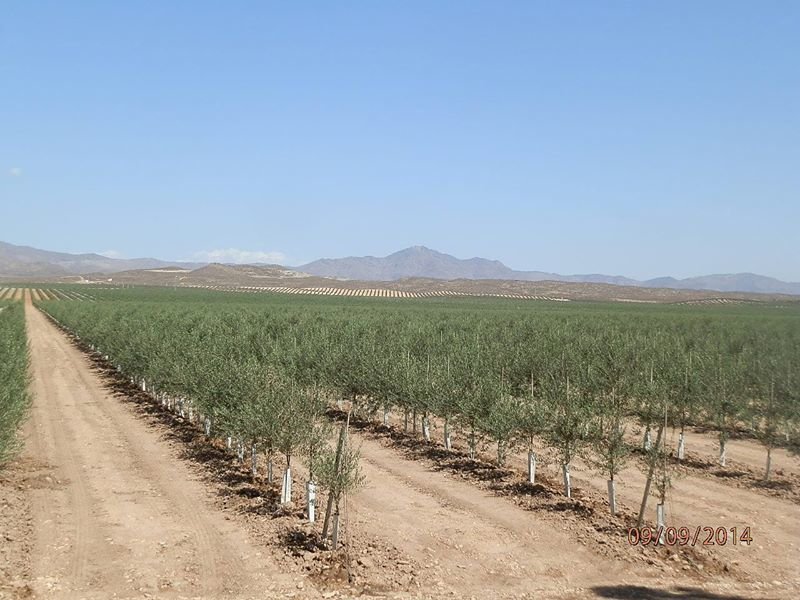
industrial, mechanized olive tree plantation on 3,600 hectares of land
that sit on top of the same aquifer that turned El Rio de Aguas in an
oasis in the desert. One million trees have already been planted on only
500 hectares, but investor Juan Carrion Caceres bought a total of 1500
hectares and plans to add another 2 million. It takes 25 times the flow
of the Rio de Aguas to irrigate the 1 million already planted, which is
why fossil underground water that has accumulated over millions of years
is now pumped up at great speed. As soon as there are 2 million more
trees, at least 1 billion litres of water per year will be needed, 3 to 5
times more than the total rainfall falling on the water basin and 75
times the flow of the river. Already, water tables and the flow in the
Rio de Aguas have dropped sharply, making life extremely difficult for
all villagers downstream. But in the face of these facts, David refuses
to see the investor as evil ‘I can only presume that he is unaware of
the catastrophe that he is bringing on our communities.’
Olive trees are of course not the issue
here. Olives are connected to life in the Mediterranean like salt is
connected to the sea. The issue is the industrial method. First, the
land is stripped naked and bulldozed until all slopes are at around 20
degrees to allow for mechanized harvesting using grape picking
machinery, harvesting at two hectares per hour. The planting of up to
9,000 trees a day uses laser technology and all trees are treated with
herbicide. ‘It is like mining everything flat, piercing the land,
poisoning it and sucking up all the ancient water to drip-feed export
products.’
David versus Goliath
Communities from Brazil, Cameroon or
Indonesia might recognise both the industrial tree plantation problem
and the David versus Goliath struggle: ‘we’re facing nepotism here: jobs
are given to friends and families, companies are closely tied to the
politicians in power and the attitude here is: if you don’t do what I
want you to do I’m going to give you trouble.’ As a result, most people
don’t want to be named because they’re afraid to stand up against
injustice perpetrated against nature and society by the rich and
powerful. ‘But that’s exactly why you have to show this mafia that it’s
not just you protesting, but that thousands of people are behind you,
including people of power and influence.’
So how did David get this campaign
started? ‘We had a torrential rain in 2012 and after that the water
situation was good. But six months later, the river went down as if a
bath plug had been taken out.’ David emailed pictures to the University
of AlmerÃa and in July 2014, Professor Jose Maria Calaforra confirmed
what the villagers already knew: the olive plantations are severely
damaging the spring of El Rio de Aguas. In 2011 an European Union
financed report had already declared the aquifer to be 330%
over-exploited. ‘With such facts I started the campaign. Three months
later, the Facebook page on the Ecocide in Rio de Aguas has 23.000
followers. We distributed 7,000 leaflets, had coverage in local
newspapers and received tremendous support from the End Ecocide team.
Legal support is coming in from both the USA and Europe. Our call for
help is being answered.’
Meanwhile, other organisations are doing
their bit in the resistance. The Grupo Ecologista Mediterráneo (GEM or
Mediterranean Green Group) opened a criminal investigation into a
plantation of 350 hectares irrigating 600,000 olive trees without
apparent irrigation permission and without an Environmental Impact
Assesment (Gespater S.L). This represents only one tenth of the area
under olive plantations, but it’s an important diversification in the
struggle as it opens a key battleground.
Inspired by Ecuadoreans
I want to know how David copes with all
these seemingly depressing facts. ‘It helps that I used to work in
Ecuador, where the situation is much worse and the leaders of the
resistance there are amazingly brave and strong. My fight here is
easier. I do not think that I will be criminalized and arrested for
protecting our water and our lives (2). There is no need to feel down
when I am working with such spirited people in Ecuador. It also helps
that there is a strong solidarity here in Rio de Aguas. I live in a
global circle of friendship, confidence, trust and help, which avoids
fear and anger. Look at our campaign: there’s no judgment, no anger. The
whole campaign is about facts.’
But these facts are so depressing that I
still wonder how David beams with positive energy. Only in the end of
the interview I start to understand how he does it. ‘It’s essential to
enjoy what we’re doing. We’re going to enjoy the intensity of this
experience every bit of the way. We’re soon organising a music festival
for 300 to 500 people. We keep talking about facts and with the festival
people can’t ignore it. It is happening. But you have to have
compassion for those who don’t understand – you cannot become
judgmental, and that is the hard part. Don’t fight it, allow it. Don’t
move into a confrontational situation. I try to expand the box without
belittling the other person. It also helps that here in the valley I
have a super-direct connection to the ecosystem and everybody here has
that, somewhere inside. It’s here that we can and must reawaken the idea
that we are the custodians of the planet and to stop acting like
rapists and parasites; that we need to work for the well-being of nature
and the biosphere, our life-support system. My mission is to raise that
awareness of the total interdependence. We have to disengage from the
consumer society which is blinding us to the reality of nature. I’m part
of nature, part of the micro-organisms, and so are you. We are not
masters, but a part of the system. We have to stop denying this.’
It seems that globetrotting David has
moved once more to settle down in this most energetic and promising
place, or rather sphere, which Naomi Klein eloquently describes as
Blockadia: the land of people connected to place but also globally
united in their struggle for environmental justice.
(1) Eco-cide derives from the Greek “oikos” meaning “house” or “home” and the Latin “caedere” meaning “strike down, demolish, kill”. It literally translates to killing our home. Ecocide is the destruction of our natural environment. Defined as the extensive damage to, destruction of or loss of ecosystems of a given territory it covers all major environmental disasters. More information on ending ecocide is here.
(2) In between recording and
pubishing this interview, José Isidro Tendetza Antun, one of David’s
Ecuadorian friends and a leader from the Shuar resisting the Mirador
mine project, was found dead. See our reporting on that here. David asked us to include the following lines in this interview:
“José Isidro Tendetza Antun was our
companion, we bought him his ticket to Lima. This was a great man who
devoted and gave his life in the protection of his territory, his land,
and for the lives of his people. This man has become a martyr for the
land of the Ecuatorian Amazon, and for the Shuar Nation. We honor,
remember and hold his inspiring words in our hearts. May our warrior
friend rest in peace.” On the facebook page of Ecocide El Rio de Aguas Spain there’s also a tribute video.
More info
The issue of industrial tree plantations is covered in depth in EJOLT report 3: An overview of industrial tree plantations in the global South. Conflicts, trends and resistance struggles
------------------------------------------------------------
The YouTube link is of my 5 minute film presentation of our situation in El Rio, which I gave in the UN Building in Geneva as a reason why we need Rights for Nature. This is an adventure. !
Thursday, 11 December 2014
David versus Goliath in Blockadia: the land of people connected to place but also globally united in their struggle for environmental justice
http://www.ejolt.org/2014/12/ending-ecocide-almeria/
Ending ecocide in Almeria
Posted by Nick on
December 9th, 2014
By Nick Meynen.
You don’t expect smiles and jokes from a
man who lives in a village that’s facing extinction due to ecocide (1).
But David Dene (66), a UK-born globetrotter, is beaming with energy and
happiness. The story he brings us is the story of Rio de Aguas, the
eco-village in Almeria (Spain) where he settled in the late nineties.
It’s a remarkable story about extraction versus renewal. About a
real-life David vs Goliath battle, where Goliath stands for a much
bigger and destructive enemy.
Ecocide at Rio de Aguas
People have been living in the Rio de
Aguas area since Neolithic times – despite the semi-arid climate and the
fragile ecosystem. This is one of the last wild places in Spain. The
landscape is dotted with caves and cliffs. The desert of Tabernas, where
Westerns were shot, is just seven kilometres away. The difference
between Rio de Aguas and Tabernas is that Rio de Aguas is fed by a
spring from a very ancient aquifer, which makes a huge difference in
ecosystem. The Natural Park around Rio de Aguas has wild goats, wild
cats and turtles, and many types of cactuses, fig trees and flowers.
That semi-arid paradise is now under
threat, including the people living in it. The Department of the
Environment has allowed a change of land usage, allowing “agricultural
production” on the aquifer. Permission has been granted for an
industrial, mechanized olive tree plantation on 3,600 hectares of land
that sit on top of the same aquifer that turned El Rio de Aguas in an
oasis in the desert. One million trees have already been planted on only
500 hectares, but investor Juan Carrion Caceres bought a total of 1500
hectares and plans to add another 2 million. It takes 25 times the flow
of the Rio de Aguas to irrigate the 1 million already planted, which is
why fossil underground water that has accumulated over millions of years
is now pumped up at great speed. As soon as there are 2 million more
trees, at least 1 billion litres of water per year will be needed, 3 to 5
times more than the total rainfall falling on the water basin and 75
times the flow of the river. Already, water tables and the flow in the
Rio de Aguas have dropped sharply, making life extremely difficult for
all villagers downstream. But in the face of these facts, David refuses
to see the investor as evil ‘I can only presume that he is unaware of
the catastrophe that he is bringing on our communities.’
Olive trees are of course not the issue
here. Olives are connected to life in the Mediterranean like salt is
connected to the sea. The issue is the industrial method. First, the
land is stripped naked and bulldozed until all slopes are at around 20
degrees to allow for mechanized harvesting using grape picking
machinery, harvesting at two hectares per hour. The planting of up to
9,000 trees a day uses laser technology and all trees are treated with
herbicide. ‘It is like mining everything flat, piercing the land,
poisoning it and sucking up all the ancient water to drip-feed export
products.’
David versus Goliath
Communities from Brazil, Cameroon or
Indonesia might recognise both the industrial tree plantation problem
and the David versus Goliath struggle: ‘we’re facing nepotism here: jobs
are given to friends and families, companies are closely tied to the
politicians in power and the attitude here is: if you don’t do what I
want you to do I’m going to give you trouble.’ As a result, most people
don’t want to be named because they’re afraid to stand up against
injustice perpetrated against nature and society by the rich and
powerful. ‘But that’s exactly why you have to show this mafia that it’s
not just you protesting, but that thousands of people are behind you,
including people of power and influence.’
So how did David get this campaign
started? ‘We had a torrential rain in 2012 and after that the water
situation was good. But six months later, the river went down as if a
bath plug had been taken out.’ David emailed pictures to the University
of AlmerÃa and in July 2014, Professor Jose Maria Calaforra confirmed
what the villagers already knew: the olive plantations are severely
damaging the spring of El Rio de Aguas. In 2011 an European Union
financed report had already declared the aquifer to be 330%
over-exploited. ‘With such facts I started the campaign. Three months
later, the Facebook page on the Ecocide in Rio de Aguas has 23.000
followers. We distributed 7,000 leaflets, had coverage in local
newspapers and received tremendous support from the End Ecocide team.
Legal support is coming in from both the USA and Europe. Our call for
help is being answered.’
Meanwhile, other organisations are doing
their bit in the resistance. The Grupo Ecologista Mediterráneo (GEM or
Mediterranean Green Group) opened a criminal investigation into a
plantation of 350 hectares irrigating 600,000 olive trees without
apparent irrigation permission and without an Environmental Impact
Assesment (Gespater S.L). This represents only one tenth of the area
under olive plantations, but it’s an important diversification in the
struggle as it opens a key battleground.
Inspired by Ecuadoreans
I want to know how David copes with all
these seemingly depressing facts. ‘It helps that I used to work in
Ecuador, where the situation is much worse and the leaders of the
resistance there are amazingly brave and strong. My fight here is
easier. I do not think that I will be criminalized and arrested for
protecting our water and our lives (2). There is no need to feel down
when I am working with such spirited people in Ecuador. It also helps
that there is a strong solidarity here in Rio de Aguas. I live in a
global circle of friendship, confidence, trust and help, which avoids
fear and anger. Look at our campaign: there’s no judgment, no anger. The
whole campaign is about facts.’
But these facts are so depressing that I
still wonder how David beams with positive energy. Only in the end of
the interview I start to understand how he does it. ‘It’s essential to
enjoy what we’re doing. We’re going to enjoy the intensity of this
experience every bit of the way. We’re soon organising a music festival
for 300 to 500 people. We keep talking about facts and with the festival
people can’t ignore it. It is happening. But you have to have
compassion for those who don’t understand – you cannot become
judgmental, and that is the hard part. Don’t fight it, allow it. Don’t
move into a confrontational situation. I try to expand the box without
belittling the other person. It also helps that here in the valley I
have a super-direct connection to the ecosystem and everybody here has
that, somewhere inside. It’s here that we can and must reawaken the idea
that we are the custodians of the planet and to stop acting like
rapists and parasites; that we need to work for the well-being of nature
and the biosphere, our life-support system. My mission is to raise that
awareness of the total interdependence. We have to disengage from the
consumer society which is blinding us to the reality of nature. I’m part
of nature, part of the micro-organisms, and so are you. We are not
masters, but a part of the system. We have to stop denying this.’
It seems that globetrotting David has
moved once more to settle down in this most energetic and promising
place, or rather sphere, which Naomi Klein eloquently describes as
Blockadia: the land of people connected to place but also globally
united in their struggle for environmental justice.
(1) Eco-cide derives from the Greek “oikos” meaning “house” or “home” and the Latin “caedere” meaning “strike down, demolish, kill”. It literally translates to killing our home. Ecocide is the destruction of our natural environment. Defined as the extensive damage to, destruction of or loss of ecosystems of a given territory it covers all major environmental disasters. More information on ending ecocide is here.
(2) In between recording and
pubishing this interview, José Isidro Tendetza Antun, one of David’s
Ecuadorian friends and a leader from the Shuar resisting the Mirador
mine project, was found dead. See our reporting on that here. David asked us to include the following lines in this interview:
“José Isidro Tendetza Antun was our
companion, we bought him his ticket to Lima. This was a great man who
devoted and gave his life in the protection of his territory, his land,
and for the lives of his people. This man has become a martyr for the
land of the Ecuatorian Amazon, and for the Shuar Nation. We honor,
remember and hold his inspiring words in our hearts. May our warrior
friend rest in peace.” On the facebook page of Ecocide El Rio de Aguas Spain there’s also a tribute video.
More info
The issue of industrial tree plantations is covered in depth in EJOLT report 3: An overview of industrial tree plantations in the global South. Conflicts, trends and resistance struggles
Wednesday, 29 October 2014
Tuesday, 14 October 2014
Wednesday, 17 September 2014
Protecting ourselves against Ecocide
I am sorry not to have posted anything for such a long time. For the last 10 weeks we have been "full on" protecting our existence.
Things are moving well with 20,000 people on our Facebook site, a World Live presentation with the End Ecocide Team, two bridges into the European Commission, two denuncios and yesterday a criminal denuncio against a 600,000 olive tree plantation. 5,000 flyers distributed on music festivals, citizens law being drafted for Leucanaena del Torres, and our October 18th event publicized on the web site for The Global Alliance for The Rights of Nature.
In November Stanko and Julian will come and make a documentary.
We have been busy. !
Check out our Facebook Page. Big hugs, David.
https://www.facebook.com/pages/Ecocide-El-Rio-De-Aguas-Spain/279736038884914
Things are moving well with 20,000 people on our Facebook site, a World Live presentation with the End Ecocide Team, two bridges into the European Commission, two denuncios and yesterday a criminal denuncio against a 600,000 olive tree plantation. 5,000 flyers distributed on music festivals, citizens law being drafted for Leucanaena del Torres, and our October 18th event publicized on the web site for The Global Alliance for The Rights of Nature.
In November Stanko and Julian will come and make a documentary.
We have been busy. !
Check out our Facebook Page. Big hugs, David.
https://www.facebook.com/pages/Ecocide-El-Rio-De-Aguas-Spain/279736038884914
Sunday, 20 July 2014
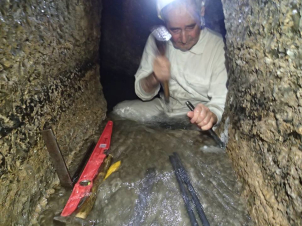
This is a tunnel we have just started cleaning. We do not know where it goes. The Professor estimates that these tunnels are around 2,000 years old. ! This tunnel is coming from inside the mountain. The water from this tunnel is our only source of water for all our vegetable irrigation and for our village supply. All we can do is clean the tunnel down to the rock floor. We have no idea how long it is or where it will lead. Height is about 1 meter, width about 1 meter, so this is a hands and knees job. A good adventure. !
Tuesday, 15 July 2014
Sunday, 13 July 2014
Chamelion on video plus the sounds of Nature. !
Theresa has created this little You Tube video. Brilliant. Lucas is both a Photographer and a Gardener.
https://www.youtube.com/watch?v=Q0OUhbxErKM
and here is a link http://en.wikipedia.org/wiki/Chameleon
to tell you lots about Chameleons. !
https://www.youtube.com/watch?v=Q0OUhbxErKM
and here is a link http://en.wikipedia.org/wiki/Chameleon
to tell you lots about Chameleons. !
Saturday, 12 July 2014
Friday, 11 July 2014
Êl Rio De Aguas water supply threatened by severe over exploitation of fossil waters . Insufficiemnt water to maintain eco system. ! Radioactivity found in Sorbas drinking water. Bore hole closed. !
A LA
CONSEJERIA DE MEDIO AMBIENTE Y ORDENACION DEL TERRITORIO DE LA JUNTA
DE ANDALUCIA EN ALMERIA.
FACTS:
In a letter to the Ministry of Environment and Planning, dated June 25, we expressed our concern about the decrease in the flow of the “Manantial” de Los Molinos del Rio Aguas.
The exploitation of the aquifer, and the consequent decline in hydraulic pressure, has caused a cone of of depression to appear within the aquifer. Even if the exploitations were to be stopped now, it would take decades for the spring to recover.
FACTS:
In a letter to the Ministry of Environment and Planning, dated June 25, we expressed our concern about the decrease in the flow of the “Manantial” de Los Molinos del Rio Aguas.
The
spring has suffered a decline from 40 Litres a second to 15 L / s.
According to our data from the spring, this will be insufficient to
maintain the ecosystem of El Rio De Aguas. and the integrity of the
“Paraque Natural del Karst y Yesso of Sorbas”.
The
spring is fed from the high basin of the “Aquifer Del Aguas”
(Ref: 060.008).
The
feed is enabled by a large inertial flow of underground water. The
water flows through gypsum rock and detrital material of the basin,
and takes decades before upwelling at Los Molinos del Rio de Aguas.
The exploitation of the aquifer, and the consequent decline in hydraulic pressure, has caused a cone of of depression to appear within the aquifer. Even if the exploitations were to be stopped now, it would take decades for the spring to recover.
In recent
years, no measures have been taken to remedy the situation, in fact
the problem has been exacerbated by the introduction of new irrigated
agricultural land usage, especially in relation to the massive
irrigation of Olive trees.
We assume
that these changes have the authorization of the Ministry of
Agriculture within the Government of Andalucia. (ConsejerÃa de
Agricultura de la Junta de AndalucÃa.)
The
records show that when the Hydrological Plan for the Andalucian
Mediterranean Basins were written, there were two hundred and twenty
one hectares (221 hectares) of olive trees under irrigated
cultivation in the discussed area.
In 2012
The Insitute of Statistics for Andalalucia stated that in the
municipalities of Sorbas, Tabernas, Lucainena, Tahal and Uleila,
three thousand, six hundred and seventy nine hecatres (3,679
hectares), of olive trees were under irrigated cultivation.
This area
continues to grow with the addition of large extensions of
“super intensive” cultivation. These areas of “super intensive”
agricultural production are also irrigated with water
from the aquifer. i
Based
on
data from 2008, the Plan indicated that the aquifer was already over
exploited. Now, in 2014, the exploitation is much higher than
reflected in the report.
Annex 3
of the Plan for the Hydrologic Basin written by The Government of
Andalucia states:
“Not included in the preliminary list of the
MIMAM, the hydrological area 06.08. Alto Aquas cataloged in the
SRPHCS as over exploited estimates that extractions in the year 2000
exceeded by 20% the average totals evaluated by IGME.
The
increase of pumps for irrigation over the last years has led to a
situation of absolute unsustainability reaching an exploitation rate
of 3.3, which means that extractions are 230% over the mean available
resource.
This
body of water, together with the subterranean water GWB
060.034 of the “Fuente de Piedra”, are in actuality, cases of the
most unsustainable extractions in the whole area.”
Althoughnot available, there is important
continuity in hydraulic pressure recorded at the control network of
IGME . They confirm the diagnosis that since 1995 (at the end of a
drought), till 2001 , the hydraulic pressure dropped by more than 8
meters, an annual drop of around 1.5 meters, which has, since 1998,
accelerated to 3.3 meters per year. "
PROBLEMS:
PROBLEMS:
Over exploitation of aquifers, seawater intrusion and other processes of salinization.
CAUSES:
Territorial
unsustainable development models.
Insufficient
use of unconventional resources.
Existence
of illegal harvesting.
Insufficient
control of extractions.
PROBLEM:
Contamination
of springs and inland water.
CAUSES:
Bad
placement of solid waste treatment plants.
For
this we feel that such authorizations should not be granted for an
aquifer in such a quantitatively bad condition thus following the Water
Directive Framework, and the Hydrological Plan for the Mediterranean
Basin of Andalucia.
In
the light of the aforesaid, this institution is required to take
action to prevent the further exacerbation of this situation.
Consequently,
this institution is obliged to take measures to prevent the
continuing exacerbation of the problem, and not to postpone the
attainment of good status in the aquifer until 2027.
In
this situation with continuing extractions from the aquifer for
existing plantations, and with more plantations planned for the
immediate future it will be impossible to comply with the partial
reduction of exploitation to 1,042 hectares planned for by 2015 in
order to re-establish the good condition of the aquifer by 2027.
Moreover,
we have evidence that it was necessary to deepen, and or join
aquifers in the bore holes, to maintain the flow owing to over exploitation.
It
is estimated that a depth of 400 meters has been reached, arriving at
the fossil water aquifer of Nevadofilabre-Alpujarride, where the
water may contain levels of radioactivity which would prevent it's
use as a supply.
It should be noted, that in our Association we have
the information that on the deepening of the bore hole Albarracin,
which serves Sorbas, the analysis of the water revealed
radioactivity, resulting in the sealing of the bore hole.
If this correct, to
perforate the deeper aquifer would contaminate the upper aquifer with
radioactive water unless adequate measures are taken to create
insulation.
Whichever
way we look at it, the possibility that radioactive water is being
used for irrigation, that can be over the limits established for
human consumption (Directive 2013/51 European Commission of October
22cnd., 2013) concerns us that this could have considerable negative
impact, not only for our cultivations, but for all of Almerian
Agriculture.
1.
We are empowered in the law of Access to Environmental Information
of 27/2006 in which access to environment information is declared a
basic right to be exercised by any citizen or association with
legitimate interest in the environment. We ask for the information
relative to the management and condition
and elements of the mass of water in the aquifer “AcuiferoDel
Aguas in the sector of Alto Aguas, (Sorbas, Tabernas), actions taken
in its entirety (wells, springs, bore holes), their treatment and
thei quality and quantity of these masses of water, as is the object
of this Admistrative act.
The
law added on 9 December, Ley 19/2013 establishes that the information
must be provided to the public with established limits. In this case
we are covered by a legislation giving special access, the law,
27/2006
For this, we SOLICIT:
1.- That you give us the
following information:
- The most recent data at the disposal of the Ministry concerning the network of control over the aquifer.
- The amount of land that has been authorized for transformation into irrigated land on this aquifer since the year 2000.
- The information relative to the management and state of the elements of the of the mass of water of the aquifero in the sector of the Alto Aquas (Sorbas, Tabernas), and the actions that have been taken in relation to these elements, (bore holes and springs) and the quality and quantity treatment of these waters.
2.- That the following
measures are taken urgently to prevent damage to the aquifer.:
- Make an urgent Hydrological study to allow us to know the actual state of the aquifer and it's relation to the Paraque Natural del Karst de Sorbas, the spring of Los Molinos, the supply to distinct areas of population and the quality, (especially in relation to natural radioactivity), of these waters
- Stop any new irrigation schemes until the aquifer has returned to a good condition and do not use alternative sources
- Immediately initiate control on withdrawals from existing wells, both in volume and depth and water quality, especially with regard to the possible radioactivity thereof.
- Immediately close any detected irregularities in concessions, (perforations or concessions which are not authorized. )
- Promote alternative projects, urban and agricultural, that will permit the recovery of the aquifer and the return to environmental balance
- The Water Framework Directive indicates that the costs of water use should be assumed by the users, and in this case through the regional administration responsible for the management of water, development, the use and management of it, will negate budgetary problems.
In Almeria, July 2014
Thursday, 10 July 2014
Pofessor Calaforra. Canal Sur in Almeria. Subtitled.
We have subtitled this broadcast from Almeria University. The situation is not good. !
Support is good and the End Ecocide team are taking on our "cause". They are in the process of collecting one million signatures for their End Ecocide campaign.!
Here in El Rio, all is well, though still no rain. A mere 27 mm since January. !!
I will keep you posted on our progress. and how our campaign is going.
Blessings, David.
We have subtitled this broadcast from Almeria University. The situation is not good. !
Support is good and the End Ecocide team are taking on our "cause". They are in the process of collecting one million signatures for their End Ecocide campaign.!
Here in El Rio, all is well, though still no rain. A mere 27 mm since January. !!
I will keep you posted on our progress. and how our campaign is going.
Blessings, David.
Tuesday, 17 June 2014
Here are some more pictures showing you how dry it is here.
Looking across towards Sorbas which is on the left, and the Filabres are the hills in the distance .
Starting to look like a desert. !
Two hot dogs, Favia and Fidel.
Things are looking better in the village. !
Tuesday, 10 June 2014
Thursday, 22 May 2014
Subscribe to:
Posts (Atom)